Case Study - Modernizing the Ring My Stylist Booking Platform with Tailwind CSS
Modernizing the Ring My Stylist Booking Platform with Tailwind CSS
- Client
- Ring My Stylist
- Year
- Location
- United States
- Service
- Frontend Redesign and Performance Optimization
Case Study
Modernizing the Ring My Stylist Booking Platform with Tailwind CSS
Overview
Ring My Stylist is a cloud-based appointment booking platform designed for independent beauty professionals, barbers, and stylists. The platform allows users to manage bookings, services, payments, and client communication on both desktop and mobile devices.
As part of a recent front-end redesign, the Web3Box team modernized the user interface using Tailwind CSS — a utility-first framework that helped improve the platform’s speed, design consistency, and developer velocity.
Challenge
The original styling of the Ring My Stylist web app relied on traditional CSS frameworks and custom component libraries, resulting in a bulky codebase that was harder to maintain. As the platform scaled with more users, service types, and interface variations, we faced key frontend challenges:
- Bloated CSS files are impacting load time
- Inconsistent spacing, alignment, and responsive behavior across screens
- Slow design iterations due to disconnected CSS class logic
- Difficulty customizing components without breaking styles
We needed a system that was both lightweight and scalable — something that would streamline our design process and improve performance on mobile, where most users access the platform.
Solution
We chose to adopt Tailwind CSS progressively during the redesign. Since Ring My Stylist uses Vue.js on the frontend, the integration was seamless and allowed for rapid iteration.
Key Steps We Took:
- Customized Tailwind’s design system to match the Ring My Stylist brand — including color palettes, typography, spacing, and shadows.
- Used Tailwind’s Just-In-Time (JIT) compiler to generate only the CSS classes we actually use, significantly reducing output size.
- Refactored component styles using Tailwind utility classes, eliminating the need for separate style files.
- Implemented a responsive design system with mobile-first breakpoints to improve usability across devices.
- Leveraged Tailwind plugins for forms, typography, and aspect ratios — simplifying otherwise complex UI logic.
Results
The impact of using Tailwind CSS was immediate and measurable:
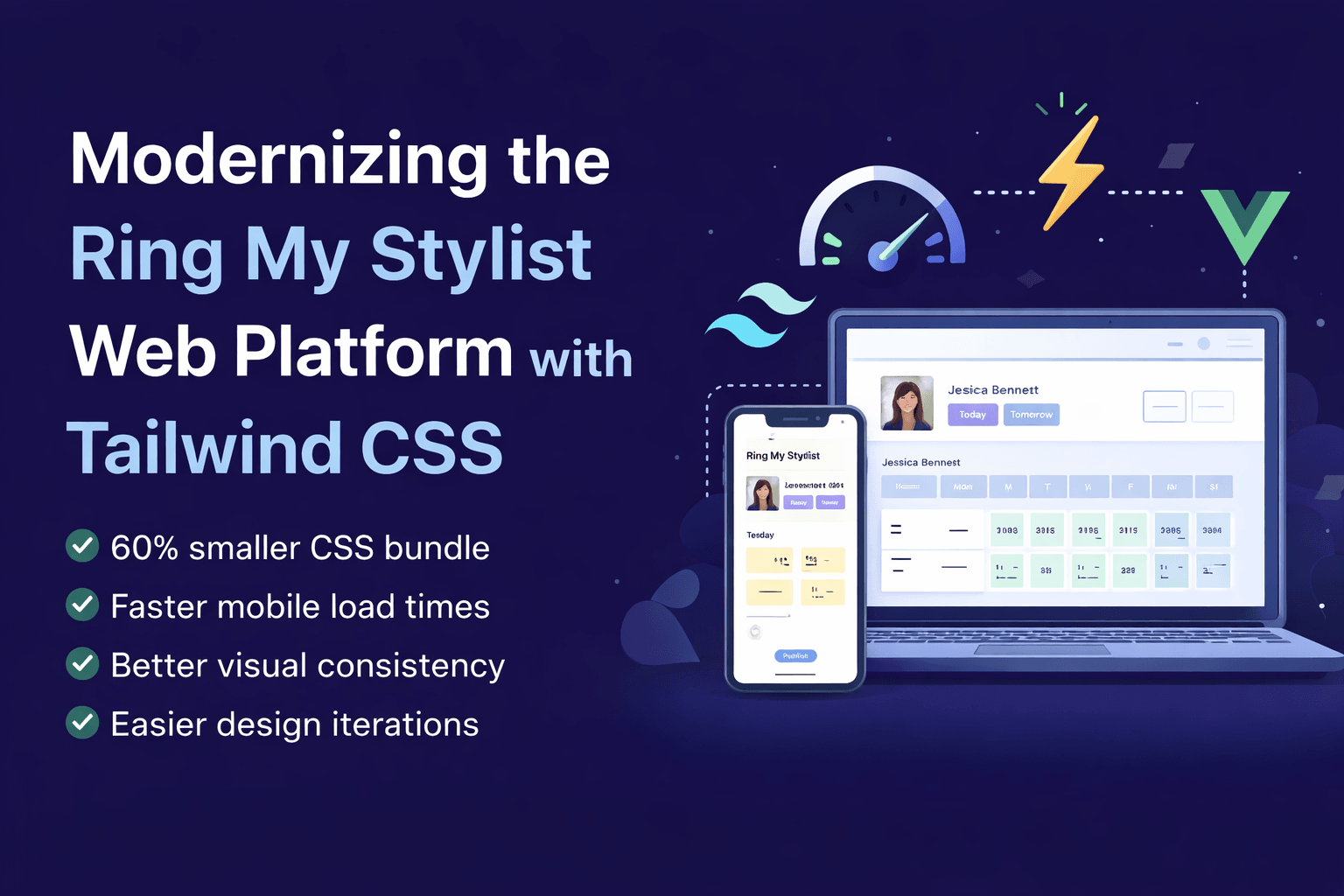
- CSS payload reduced by over 60%, improving initial page load speed
- Faster design & prototyping — developers and designers could implement new screens directly in code
- Improved visual consistency across hundreds of user interface elements
- Mobile responsiveness optimized, reducing user friction for booking actions
- Cleaner, more maintainable codebase, easier for new developers to onboard
Why Tailwind CSS Works for Booking Platforms
Booking platforms like Ring My Stylist require clean, fast, and mobile-friendly UIs. Tailwind CSS gives teams:
- A consistent visual language using utility classes
- Built-in responsiveness without extra media queries
- The ability to quickly build and iterate on custom components
- Smaller CSS files thanks to JIT compilation
- Faster page loads — which can mean fewer booking drop-offs
All of this leads to better UX, higher booking completion rates, and more flexibility for platform growth.
Key Takeaways
- Tailwind CSS can dramatically simplify complex UI workflows
- Its utility-first model fits perfectly with modern JavaScript frameworks like Vue.js
- The performance benefits go beyond development — users feel the difference
- Adopting Tailwind is an investment in both design velocity and frontend maintainability
Project Details
- Client: Ring My Stylist (https://book.ringmystylist.com/)
- Tech Stack: Vue.js, Tailwind CSS (JIT), Laravel (backend), MySQL
- Scope: Frontend redesign and performance optimization
- Team: 1 UI/UX Designer, 2 Frontend Engineers, 1 QA, 1 Project Manager